The Basilica Cistern: A Testament to Byzantine Engineering
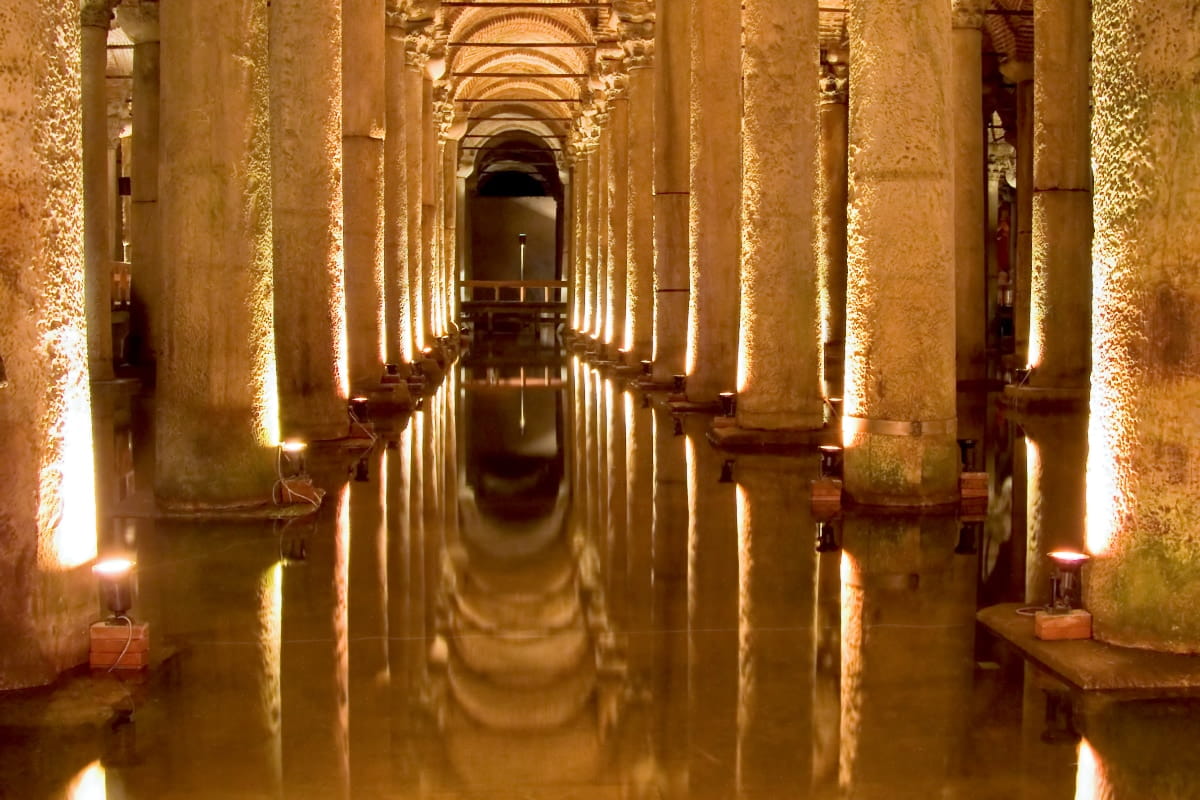
Stepping off the vibrant, bustling streets of the Sultanahmet district and descending the damp stone stairs into the earth feels like crossing a threshold between worlds. The air instantly cools, the sounds of the modern city fade into a heavy silence broken only by the rhythmic dripping of water, and your eyes adjust to a dim, golden twilight. This is the Basilica Cistern, known locally as Yerebatan Sarnıcı (The Sunken Palace), and it is far more than just an ancient water tank. It is a profound statement of power, foresight, and engineering genius that has survived earthquakes, conquests, and the ravages of time since the 6th century. For travelers visiting Istanbul in early 2026, the cistern remains one of the most evocative examples of how the Byzantine Empire mastered the art of infrastructure.
While many visitors are captivated by the atmospheric lighting and the swimming carp, the true story lies in the structural bones of the cavern. Built under the reign of Emperor Justinian I in 532 AD, this subterranean giant was designed to serve the Great Palace and surrounding buildings. The sheer audacity of constructing such a massive reservoir—capable of holding 80,000 cubic meters of water—underneath a dense urban center is a testament to the sophisticated understanding of hydraulics and load-bearing architecture possessed by Byzantine engineers. It wasn't merely about storing water; it was about securing the survival of the city against droughts and sieges.
The Vision of Justinian: Context and Construction
The construction of the Basilica Cistern was born out of necessity and political turmoil following the Nika Riots, which had devastated much of the city. Emperor Justinian I sought to rebuild Constantinople grander than before, and water security was a top priority. Historical records suggest that over 7,000 slaves were involved in the construction, working tirelessly to excavate the earth and arrange the massive stone blocks. The location was strategic, situated beneath the Stoa Basilica, a large public square, which allowed for the collection of rainwater and the storage of water brought in via aqueducts. This project was not just a utilitarian endeavor; it was a display of imperial capability, proving that the empire could tame nature to serve its capital.
What makes the cistern truly remarkable is the speed at which it was completed relative to its complexity. The engineers had to calculate the pressure of the water against the walls and the weight of the city above the roof. They utilized a rectangular plan measuring approximately 140 meters by 70 meters, covering a total area of about 9,800 square meters. To support the immense weight of the brick vaults above, they erected a forest of marble columns. These columns were not hewn specifically for the cistern but were largely repurposed from ruined temples and older structures across the empire, a practice known as 'spolia'. This recycling was both an economic necessity and a subtle show of dominance over the past.
Architectural Ingenuity Beneath the Surface
The engineering techniques employed in the Basilica Cistern were centuries ahead of their time, particularly regarding structural integrity and waterproofing. The roof is supported by 336 marble columns, each standing 9 meters high, arranged in 12 rows of 28 columns each. The spacing is precise—4.8 meters between each column—creating a perfect grid that distributes the load evenly. This repetition creates the mesmerizing 'endless forest' effect that visitors experience today. However, the true engineering hero is the roof itself. The ceiling consists of cross-vaulted arches made of fired brick, a material chosen for its lightness and durability compared to stone slabs.
The Secret of Waterproofing: Khorasan Mortar
One of the most critical challenges in building a cistern is preventing leakage. If the water seeped out, the foundations of the nearby Hagia Sophia and other structures could be compromised. Byzantine engineers solved this with a special material known as Khorasan mortar. The walls of the cistern are 4.8 meters thick, constructed of firebrick, and coated with this hydraulic mortar. It is a mixture of crushed brick, lime, and pozzolanic ash, which creates a waterproof seal that actually hardens over time when exposed to moisture. This innovative chemical composition is the primary reason the cistern is still watertight today, nearly 1,500 years later.
Structural Resilience and Column Styles
The columns themselves tell a story of architectural diversity. Since they were salvaged from various locations, they feature different styles, primarily Corinthian and Doric. This mix-and-match approach required careful engineering to ensuring stability. Some columns were too short and had to be placed on plinths; others were too long and were trimmed. The engineers used lead sheets between the column capitals and the arches to act as shock absorbers during earthquakes. This seismic isolation technique allowed the rigid structure to move slightly without collapsing, a brilliant adaptation in an earthquake-prone region like Istanbul.
- Corinthian Columns: The majority of the columns feature intricate floral capitals, adding a touch of elegance to the industrial space.
- Doric Columns: Simpler and sturdier, these are fewer in number but provide a visual contrast.
- The Crying Column: One specific column is engraved with teardrop shapes and remains perpetually wet, often associated with the tears shed for the slaves who died during construction.
The Medusa Heads: Engineering Pragmatism or Myth?
Perhaps the most famous features of the Basilica Cistern are the two giant Medusa heads used as bases for columns in the northwest corner. One head is positioned upside down, and the other is tilted on its side. While mythology lovers enjoy the stories of petrification and warding off evil spirits, the reality is likely a prime example of Byzantine engineering pragmatism. The columns in this section were likely slightly too short for the vaulted ceiling height. The engineers needed large, sturdy blocks to act as plinths to raise the columns to the correct level. The Medusa heads, likely taken from a Roman-era building (possibly the Temple of Apollo in Didyma), were simply the right size.
Placing them upside down or sideways negated their power as pagan idols in a Christian empire, while perfectly serving the structural need. It is a fascinating intersection where cultural shifting meets architectural necessity. Today, they sit in the shallow water, illuminated by dramatic lights, serving as a reminder of how the Byzantines viewed the physical remnants of the classical world: as useful raw materials for their own grand designs.
Technical Specifications at a Glance
To truly appreciate the scale of this project, it is helpful to look at the raw data that defines the structure. The following table breaks down the key technical aspects of the Basilica Cistern, highlighting the magnitude of the construction effort.
| Feature | Specification |
| Construction Date | 532 AD (Reign of Justinian I) |
| Dimensions | 140m x 70m (approx. 9,800 m²) |
| Water Capacity | Approximately 80,000 - 100,000 tons |
| Number of Columns | 336 columns |
| Column Height | 9 meters |
| Wall Thickness | 4.8 meters (firebrick and mortar) |
| Water Source | Belgrade Forest via Valens Aqueduct (19 km) |
The Hydraulic System and Water Management
The Basilica Cistern was not an isolated unit; it was the terminus of a massive hydraulic network. The water was brought from the Belgrade Forest, located 19 kilometers north of the city, via the Valens Aqueduct and the Mağlova Aqueduct. This required precise topographical calculations to maintain a consistent gradient that would allow gravity to transport the water over such a long distance. Once the water reached the city, it passed through sedimentation tanks to filter out debris before entering the cistern. This attention to water quality and distribution highlights that the Byzantines were not just master builders, but also advanced civil engineers concerned with public health and logistics.
A Timeless Legacy
Walking through the cistern today, with the soft ambient lighting reflecting off the dark water and the columns casting long shadows, one cannot help but feel a deep sense of respect for the ancient architects. The Basilica Cistern is more than a tourist attraction; it is a surviving document of Byzantine resilience. It showcases how they solved complex problems of load-bearing, waterproofing, and logistics with the materials available to them. For the modern traveler exploring Istanbul, it serves as a quiet, majestic reminder that while empires may fall, great engineering can stand against the tide of time.
Today, the Basilica Cistern is a meticulously restored and maintained museum, offering visitors a unique glimpse into the past. The walkways are raised above the water level, allowing for easy exploration, and the strategic lighting enhances the mystical atmosphere. Visitors can now appreciate the grandeur of the cistern while learning about its history and engineering through informative displays. The presence of the carp, carefully managed to maintain the ecosystem, adds another layer of intrigue. The cistern is a popular destination, often crowded, so booking tickets in advance is recommended, especially during peak tourist season. The experience is truly unforgettable, offering a tangible connection to the ingenuity of the Byzantine Empire.